

Why AI bots matter in 2026
The crypto market has undergone a structural shift. The maturation of spot ETFs and increased institutional participation have professionalized the landscape, raising the bar for retail traders. In this environment, manual trading is no longer sufficient. AI crypto trading bots 2026 are now a necessity, not a novelty, for anyone looking to compete.
Institutional players operate with algorithmic execution and real-time data processing that human traders cannot match. They react to market movements in milliseconds, adjusting positions based on complex variables that would overwhelm a manual trader. For retail investors, relying on intuition or simple chart patterns is a losing strategy against these automated systems.
Risk Note: AI trading bots are tools, not profit generators. They execute strategies based on your parameters. If your strategy is flawed, the bot will execute it efficiently, leading to rapid losses. Always backtest and start with small capital.
This shift means that AI crypto trading bots 2026 serve as the great equalizer. They provide retail traders with access to quantitative analysis, risk management protocols, and 24/7 market monitoring previously reserved for hedge funds. The key is not just having a bot, but choosing one that aligns with your specific risk tolerance and market view.
5 AI Crypto Trading Bots for 2026
Selecting the right AI crypto trading bots for 2026 requires rigorous verification against official documentation, given the high-stakes nature of automated financial execution. The following five platforms—Pionex, 3Commas, Cryptohopper, HaasOnline, and Bitsgap—are evaluated based on their documented AI capabilities and security protocols.
1. 3commas ai trading bot
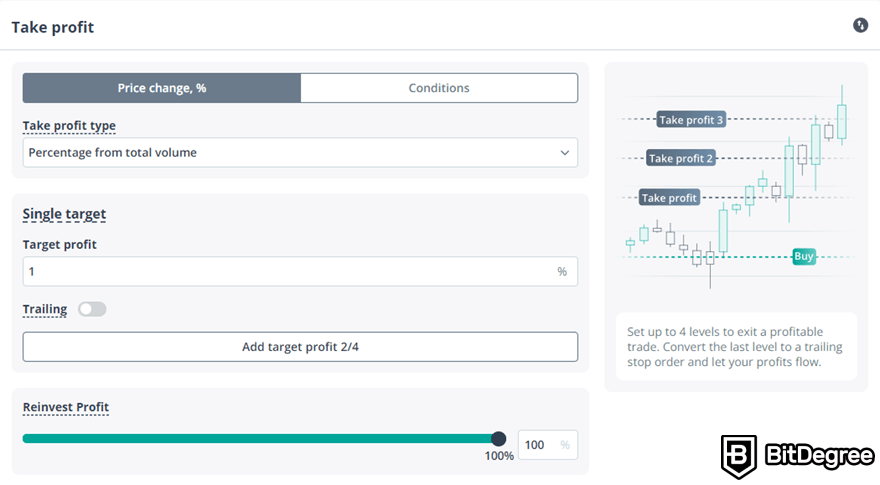
3Commas integrates advanced AI logic into its smart trade terminal, allowing users to automate complex strategies across multiple exchanges. This platform is ideal for traders seeking granular control over DCA and grid bots while leveraging AI-driven market analysis to optimize entry and exit points.
2. pionex ai grid trading
Pionex offers built-in AI grid trading bots that automatically buy low and sell high within specified price ranges. This tool is particularly effective for sideways markets, providing a hands-off approach to capturing volatility. Users can customize grid parameters to align with their risk tolerance and market outlook without needing extensive coding knowledge.

3. cryptohopper ai strategy designer
Cryptohopper’s AI Strategy Designer uses machine learning to backtest and optimize trading strategies based on historical data. This feature helps traders identify profitable patterns and automate execution without manual intervention. It is a robust choice for those who want data-driven insights to refine their automated trading approaches in volatile crypto markets.

4. bitsgap ai arbitrage bot
Bitsgap specializes in AI-powered arbitrage bots that exploit price differences between exchanges. This tool automatically executes trades to capture small price discrepancies, generating profit from market inefficiencies. It is well-suited for traders looking to diversify income streams through low-risk arbitrage opportunities across major cryptocurrency exchanges.

5. tradesanta ai auto trading
TradeSanta provides AI-driven auto trading features that simplify strategy creation and execution for beginners and experts alike. The platform offers pre-built AI strategies that adapt to market conditions, reducing the need for constant monitoring. It is a reliable option for those seeking a user-friendly interface with automated trading capabilities.
How to choose the right AI crypto trading bots 2026
Selecting the right automated trading software requires matching your technical comfort level with the bot’s automation depth. The landscape in 2026 has shifted from simple grid bots to systems that rely on real-time data feeds and machine learning models. Before connecting your exchange API, evaluate three core factors: your ability to manage risk parameters, your need for data granularity, and the level of manual oversight you are willing to provide.
Assess your technical skill level
If you are new to algorithmic trading, avoid platforms that require writing custom Python or JavaScript code. Instead, look for bots with pre-built strategies and drag-and-drop interfaces. These tools allow you to backtest strategies against historical data without handling complex API integrations manually. For advanced users, platforms like 3Commas or Pionex offer deeper customization, including the ability to connect to CoinAPI for tick-level trade data and normalized order books. This access is critical for AI bots that need high-fidelity data to refine their predictive models.
Define your risk tolerance and automation needs
Automated bots do not trade profitably by default; they execute the risk parameters you set. Determine how much capital you are willing to lose during a volatile market swing. If you prefer a "set and forget" approach, choose bots with built-in stop-loss and take-profit mechanisms that trigger automatically. However, if you want to maintain control, select tools that offer hybrid modes where the AI suggests trades but requires your manual confirmation. Always verify that the bot’s risk management features align with your personal trading goals before deploying real funds.
Verify data quality and security
The accuracy of an AI bot is only as good as the data it ingests. Ensure the platform provides access to reliable, real-time market data. Poor data feeds can lead to slippage and incorrect signal generation. Additionally, prioritize bots that support read-only API keys. This security measure allows the bot to execute trades without the ability to withdraw funds from your exchange account, protecting your capital from potential platform vulnerabilities or API key leaks.


As an Amazon Associate, we may earn from qualifying purchases.
Common risks and safety tips
Using AI crypto trading bots 2026 brings speed and precision, but it also exposes your capital to automated errors. The market does not care about your backtest results, and a misconfigured algorithm can drain an account in minutes. Understanding the specific risks helps you protect your principal.
API Security and Permissions
The most critical safety step is how you connect your exchange. Never grant full withdrawal permissions to any bot, including popular platforms like Cryptohopper. Instead, generate read-only API keys or enable trade-only permissions. This ensures that even if the bot’s security is compromised, the attacker cannot move your funds to an external wallet. Always review the official documentation of your chosen exchange to understand the specific security protocols for API keys.
Market Volatility and Slippage
AI models are trained on historical data, but crypto markets can behave unpredictably during news events or liquidity crunches. A bot might execute a trade at a price significantly worse than expected, a phenomenon known as slippage. To mitigate this, set strict stop-loss orders and avoid using high-leverage strategies during high-volatility periods. Remember that profitability depends on strategy choice and risk control, not just the AI’s intelligence.
Over-Optimization Risks
It is tempting to tweak parameters until a bot’s past performance looks perfect. This is called over-optimization, and it often leads to failure in live trading. A strategy that works flawlessly in a backtest may fail in real-time due to changing market conditions. Stick to simple, robust strategies and monitor your bot’s performance regularly rather than assuming it will run indefinitely without oversight.
Frequently asked: what to check next
Are AI crypto trading bots profitable?
AI crypto trading bots can be profitable, but they are not profitable by default. Success depends on strategy choice, market conditions, parameter setup, and strict risk control. While tools like Cryptohopper automate execution, they do not guarantee returns. You must actively manage settings and understand that automated trading carries significant financial risk.
Which AI crypto trading bots are best for 2026?
Leading platforms for 2026 include 3Commas, Cryptohopper, Bitsgap, Pionex, TradeSanta, and Coinrule. Each offers distinct features, such as Coinrule’s rule-based logic or Pionex’s built-in exchange grid trading. Choosing the right bot requires aligning these specific capabilities with your trading experience and desired level of automation.
Will AI-driven crypto coins boom in 2026?
Several AI-focused cryptocurrencies are gaining traction in 2026, including NEAR Protocol, Bittensor, DeXe, Internet Computer, and Render. These projects integrate AI into blockchain infrastructure rather than functioning as trading bots. Investors often track these assets separately from trading software, as their value drivers differ from automated trading tools.
No comments yet. Be the first to share your thoughts!