
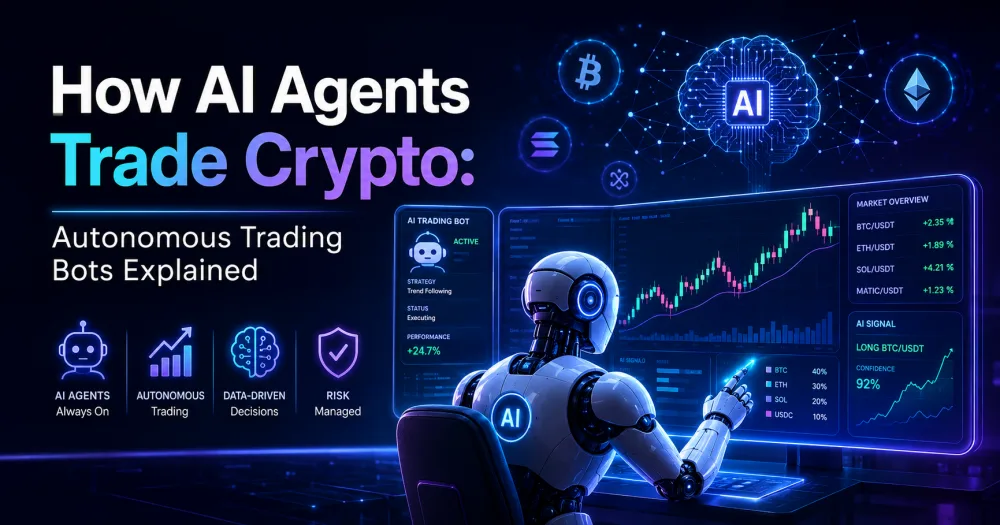
Why 2026 is the year of autonomous crypto agents
The role of artificial intelligence in cryptocurrency markets has shifted from passive analysis to active execution. In the past, AI tools primarily offered chart patterns or sentiment scores, leaving the final decision—and the click—to the human trader. This dynamic is changing rapidly as autonomous crypto agents begin combining AI logic directly with blockchain wallets. These systems now trade, pay for API access, and manage DeFi positions without human intervention.
This transition marks a significant structural change in how digital assets are managed. As noted by a16z Crypto, the industry is moving from "know your customer" (KYC) protocols to "know your agent" (KYA) frameworks. This shift reflects a new reality where the identity and behavior of the AI itself become the primary subject of trust and regulation.
2026 is being recognized as the year of AI agents because businesses are deploying systems that do more than respond—they act, decide, and execute. For crypto investors, this means the landscape is no longer just about holding tokens; it is about integrating with intelligent systems that can navigate market volatility in real time. The following section details the top five autonomous agents leading this charge.
5 Crypto AI Agents Dominating 2026: Autonomous Trading & Prediction
The 2026 crypto landscape has shifted from passive holding to active, algorithmic management, with autonomous agents now executing trades and forecasting market movements in real time. This roundup identifies five specific AI-driven platforms that are currently leading this transition through verifiable performance and transparent tokenomics.
1. Bittensor (TAO): Decentralized AI network leader
Bittensor operates as a decentralized marketplace for machine learning, where miners provide inference and validators ensure quality. This structure creates a robust, censorship-resistant network for AI model training and deployment. It stands as the foundational infrastructure layer for many autonomous agents seeking reliable computational resources without central bottlenecks.

2. Fetch.ai (FET): Autonomous economic agents
Fetch.ai enables the creation of autonomous digital agents that negotiate, transact, and optimize tasks across various sectors. These agents handle complex workflows like supply chain logistics or personalized travel booking without human intervention. By bridging data silos, FET facilitates seamless machine-to-machine commerce, driving efficiency in decentralized economic ecosystems.
3. Ocean Protocol: Data liquidity for AI agents
Ocean Protocol unlocks data liquidity by allowing data owners to monetize their datasets while preserving privacy. AI agents access high-quality, verified data for training models through secure, tokenized exchanges. This marketplace ensures that valuable information flows freely to where it is needed most, fueling smarter, more accurate autonomous decision-making processes.
4. Render (RNDR): GPU power for AI computation
Render Network connects artists and developers needing GPU power with providers who have idle hardware. This decentralized cloud rendering solution is critical for AI training and inference tasks that require massive parallel processing. By optimizing resource utilization, RNDR reduces costs and barriers to entry for building sophisticated AI models and agents.

5. Neural Protocol: On-chain AI inference
Neural Protocol focuses on bringing AI inference directly onto the blockchain, ensuring transparency and verifiability. This approach allows smart contracts to trigger AI-driven actions based on real-world data or complex calculations. By keeping the inference process on-chain, it eliminates trust assumptions and provides a tamper-proof record of AI decisions for autonomous agents.
Compare top AI agents by use case
The five leading AI agent tokens serve distinct roles in the crypto ecosystem. Comparing them side-by-side reveals that infrastructure, compute, and application layers each offer different risk and reward profiles for 2026.
| Token | Primary Focus | Key Use Case | Risk Profile |
|---|---|---|---|
| TAO | Decentralized ML | Model training & inference | High |
| FET | Autonomous Agents | DeFi & data automation | Medium |
| OCEAN | Data Privacy | Secure data marketplaces | Medium |
| RNDR | GPU Compute | 3D rendering & AI | Low-Medium |
| NEURAL | Neural Mesh | Distributed compute | High |
Bittensor (TAO) operates as a decentralized machine learning network, prioritizing model diversity over centralized control. Fetch.ai (FET) focuses on autonomous agents that execute complex DeFi tasks. Render (RNDR) provides the essential GPU compute layer that powers both rendering and AI workloads.
Hardware requirements for local AI agents
Running an AI crypto agent locally gives you full custody of your private keys and eliminates reliance on third-party API providers. However, these models demand significant computational power, particularly for inference tasks that process real-time market data. Unlike simple scripts, autonomous agents require GPUs with ample VRAM to handle large language models and complex trading algorithms without latency.
For most users, a consumer-grade workstation with a high-end NVIDIA GPU is the entry point. Models like the NVIDIA RTX 4090 offer the necessary 24GB of VRAM to run quantized versions of popular AI agents efficiently. If you plan to run multiple agents or larger, unquantized models, consider upgrading to professional-grade hardware like the NVIDIA A100 or H100, though these come with a substantially higher price tag and power consumption.
Beyond the GPU, you need sufficient RAM and fast storage. AI agents load model weights into memory, so 64GB of RAM is a safe minimum for stable operation. NVMe SSDs are essential for quick data retrieval, ensuring your agent can react to market shifts in milliseconds rather than seconds.


As an Amazon Associate, we may earn from qualifying purchases.
No comments yet. Be the first to share your thoughts!