
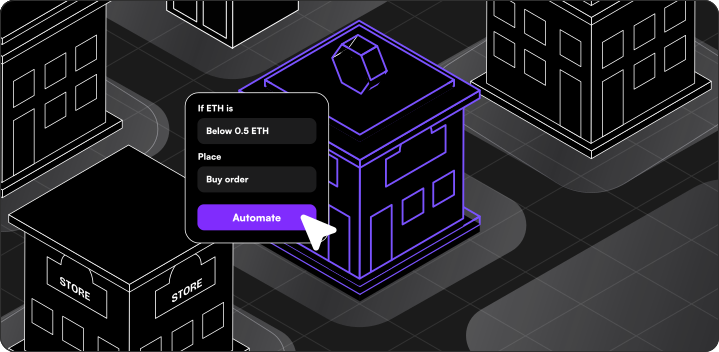
What crypto AI agents actually do
A crypto AI agent is autonomous software that holds a wallet, makes financial decisions, and executes transactions without human approval for every action. Unlike traditional trading bots that follow rigid, pre-coded rules, these agents use machine learning to analyze market data, manage portfolios, and interact with blockchain protocols independently.
Think of a standard trading bot as a driver following a strict GPS route: it executes specific commands when certain conditions are met. A crypto AI agent is more like a self-driving car. It perceives its environment, interprets complex signals, and decides whether to buy, sell, or hold based on real-time analysis. This distinction matters because autonomy introduces new capabilities—and new risks.
On networks like Ethereum, these agents range from virtual influencers to real-time market analysis platforms. They can engage with other smart contracts, pay for services, and rebalance assets across different DeFi protocols. The key difference is the decision-making layer: the agent itself determines the strategy, rather than just executing a human-defined one.
This autonomy allows for 24/7 market participation at speeds humans cannot match. However, it also means that errors in the agent’s logic can lead to immediate, irreversible financial consequences. Understanding this distinction is the first step in evaluating whether these tools fit your strategy.
Leading platforms for autonomous trading
The landscape for crypto AI agents has shifted from simple signal bots to autonomous entities capable of holding wallets and executing complex DeFi strategies. For 2026, the most effective platforms distinguish themselves by balancing robust AI logic with accessible interface design. Rather than relying on static backtests, these tools integrate with live market data to adjust positions in real time.
Choosing the right platform depends on your specific workflow: whether you need a no-code environment for quick strategy deployment or a developer-friendly SDK for custom autonomous agents. The following comparison highlights the core strengths of the leading platforms currently dominating the sector.
| Platform | Primary Strength | Skill Level | Key Integration |
|---|---|---|---|
| 3Commas | AI-Enhanced Bot Management | Intermediate | Multi-Exchange API |
| Cryptohopper | Cloud-Based Strategy Designer | Beginner | Exchange & Social Trading |
| Cod3x | Deep Customization & UX | Advanced | Custom Scripting |
| Pionex | Built-In Exchange Bots | Beginner | Pionex Exchange |
| Bitsgap | Grid Trading Automation | Intermediate | Multi-Exchange Sync |
3Commas remains a staple for traders who want AI-enhanced features layered over traditional bot management. Its strength lies in its ability to sync across multiple exchanges, allowing you to manage a unified portfolio regardless of where your assets are held. This makes it ideal for arbitrage and cross-exchange strategies that require rapid execution.
For those prioritizing ease of use, Cryptohopper offers a cloud-based environment that requires no server maintenance. Its strategy designer allows users to combine technical indicators with AI signals to create automated workflows. This platform is particularly effective for beginners who want to automate trading without writing code.
Cod3x stands out for advanced users who require deep customization. While the learning curve is steeper, its fully built-out UI/UX supports complex autonomous logic that goes beyond standard bot parameters. It is the preferred choice for developers building sophisticated agents that interact with multiple DeFi protocols simultaneously.
Pionex and Bitsgap cater to different segments of the automation market. Pionex integrates bots directly into its exchange, reducing the friction of API key management but limiting you to its ecosystem. Bitsgap focuses on grid trading and arbitrage across multiple exchanges, offering a robust tool for range-bound markets without the need for complex AI configuration.
When evaluating these platforms, consider the cost of automation against the potential for autonomous gains. Most platforms offer free tiers with limited features, allowing you to test the waters before committing to a subscription. The key is to start with a strategy that matches your current skill level and expand as you become more comfortable with autonomous trading logic.
Building custom agents on blockchain
Developing a crypto AI agent requires bridging two distinct worlds: the deterministic logic of smart contracts and the probabilistic reasoning of large language models. The architecture typically involves a "supervisor" agent that orchestrates specialized sub-agents. These collaborators analyze on-chain data, identify opportunities, and execute transactions, while a blockchain bridge handles the final settlement.
For developers, AWS Bedrock provides a robust foundation for this stack. By leveraging Bedrock, you can integrate foundational models like Claude or Llama without managing the underlying infrastructure. AWS offers a reference architecture and a GitHub repository that deploys these building blocks, allowing you to focus on the agent's decision-making logic rather than the plumbing.
The core challenge lies in security. An autonomous agent holds private keys and executes trades without human approval. This means the code must be audited rigorously, and the agent's permissions should be limited to specific smart contract interactions. Using a modular design ensures that if one sub-agent fails, the entire system doesn't collapse.
To get started, you can clone the aws-samples/crypto-ai-agents-with-amazon-bedrock repository. This example demonstrates how to connect an LLM to Ethereum nodes, enabling the agent to read balances and sign transactions based on real-time market data.
Risks and trust in autonomous systems
Autonomous trading agents operate with a speed and precision that human traders cannot match, but this efficiency comes with a steep price in risk. When software holds the keys to a crypto wallet, the margin for error vanishes. A single logic flaw or unexpected market flash crash can drain funds in seconds, leaving no time for manual intervention.
The core vulnerability lies in the smart contracts these agents interact with. Unlike traditional banking, where chargebacks might reverse a mistake, blockchain transactions are immutable. If an AI agent executes a trade based on a flawed signal or if a contract contains a hidden exploit, the loss is permanent. This reality makes the selection of a platform less about features and more about security architecture.
Trust is the currency of autonomous trading. As noted by industry analysis, trading agents need to be trusted to be effective, meaning users must verify that the AI’s decision-making logic is transparent and that the underlying infrastructure is audited. Without this trust, the speed of AI trading becomes a liability rather than an asset.
Common questions about crypto AI agents
What are crypto AI agents?
A crypto AI agent is autonomous software that operates directly on the blockchain. Unlike traditional trading bots that simply follow pre-set scripts, these agents can hold a crypto wallet, analyze market data, and make financial decisions without human approval for every action. They execute trades, manage portfolios, and even pay for services autonomously, acting as independent digital entities within the Web3 ecosystem.
What is the best AI agent in crypto?
There is no single "best" agent, as performance depends on your specific trading strategy and risk tolerance. Current market leaders include 3Commas for its AI-enhanced features, Cryptohopper for cloud-based automation, and Pionex for its built-in bot infrastructure. When selecting a platform, evaluate standout features like strategy depth, backtesting capabilities, and fee structures rather than relying on generic rankings.
Can crypto AI agents lose money?
Yes, AI agents can lose money. While they remove emotional bias and operate 24/7, they are only as good as the data and logic they are trained on. Market volatility, black swan events, or flawed algorithmic strategies can lead to significant losses. Always treat AI agents as tools that assist your decision-making, not as guaranteed profit machines, and never invest more than you can afford to lose.
No comments yet. Be the first to share your thoughts!